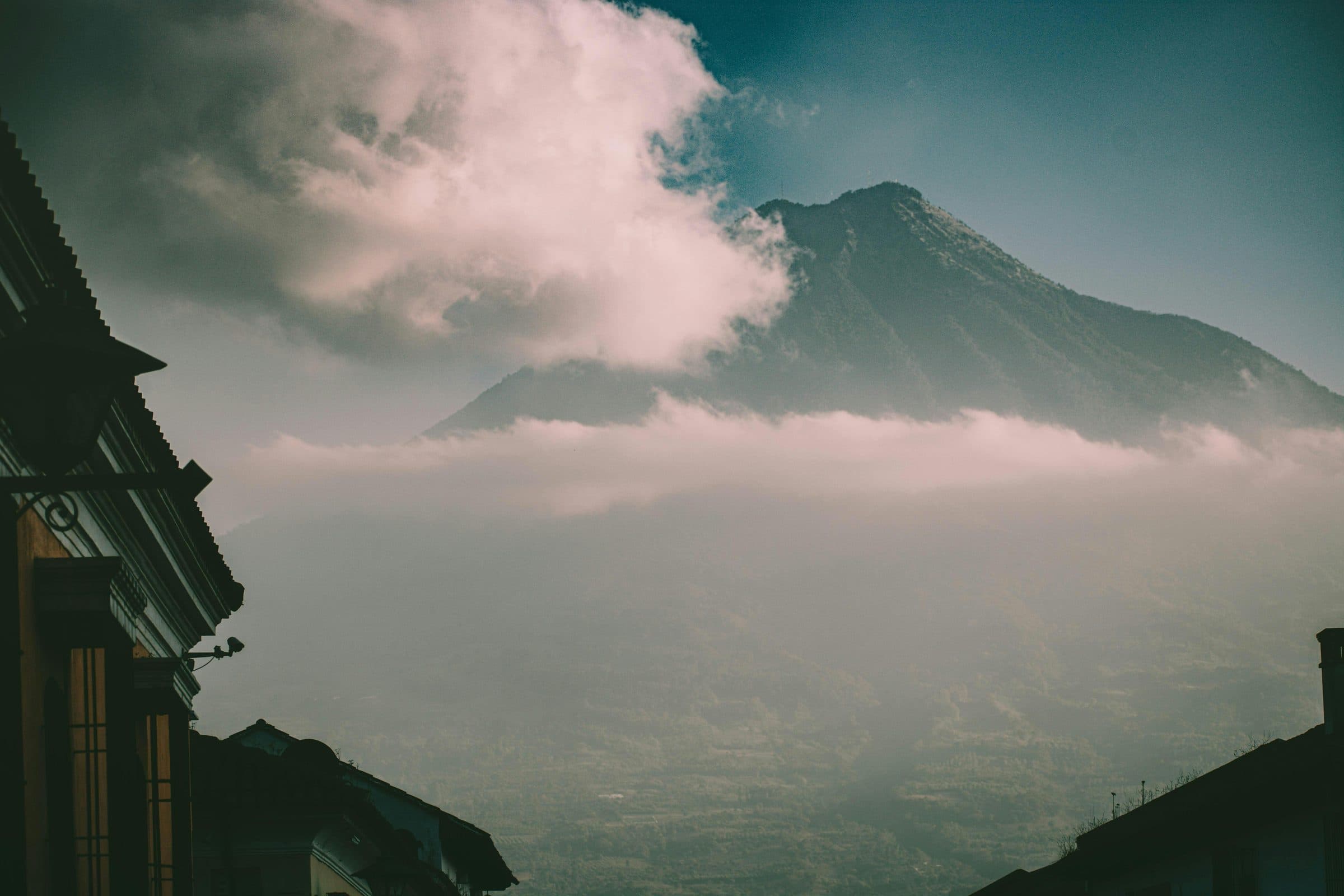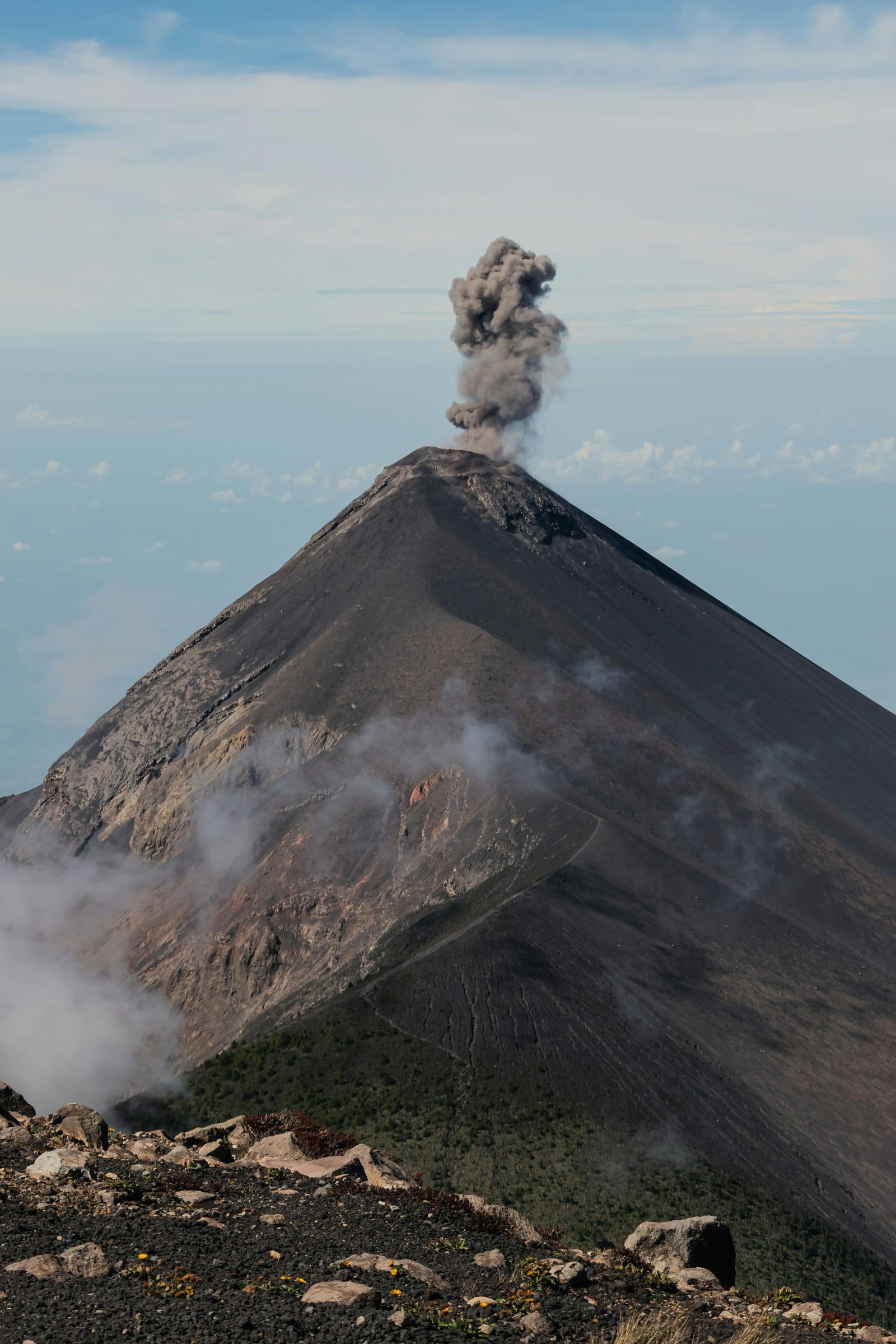
In the Acatenango Valley, the earth never quite rests. Volcán de Fuego erupts several times a week — sometimes violently, always visibly. Ash drifts across the valley like grey snow, settling on coffee leaves, on drying patios, on the shoulders of farmers who have learned to read the mountain’s moods. And yet it is precisely this volcanic violence that produces some of the most extraordinary coffee on earth.
The Valley Between Two Volcanoes
The Acatenango Valley sits in a dramatic corridor between two massive stratovolcanoes: Acatenango, which last erupted in 1972 and now slumbers under a crown of cloud forest, and Fuego, one of the most active volcanoes in Central America. The valley floor, at roughly 1,700 meters, rises steeply on both sides toward summit ridges above 3,700 meters. Coffee is grown on the slopes between 1,500 and 2,100 meters — a band of altitude where temperature, rainfall, and soil converge to create ideal conditions.
This geography creates a natural amphitheatre with its own weather system. Cool air descends from the Acatenango summit at night, dropping temperatures to 10–12°C, while daytime warmth from the Pacific lowlands pushes temperatures to 22–26°C. This diurnal temperature swing — the difference between day and night — is one of the most important factors in coffee quality. It forces the cherry to ripen slowly, concentrating sugars and developing complex organic acids over months rather than weeks.
The landscape is extraordinarily fertile. Successive eruptions over millennia have layered the valley floor with volcanic deposits rich in phosphorus, potassium, iron, and trace minerals. The soil is a loose, dark andisol with excellent drainage — it holds moisture without waterlogging roots, and provides a mineral buffet that the coffee plant draws on throughout its growing cycle.
Volcanic Soil & Mineral Richness
Volcanic soils — known geologically as andisols — are among the most nutrient-rich agricultural soils on the planet. When Fuego erupts, it deposits a fine layer of tephra across the surrounding farmland. This ash is rich in feldspar and olivine minerals that break down relatively quickly in Guatemala’s humid climate, releasing bioavailable phosphorus, calcium, magnesium, and potassium directly into the root zone.
These minerals are not just good for the plant — they shape what ends up in your cup. Phosphorus supports the metabolic pathways that produce sucrose and fructose in the cherry. Potassium regulates the plant’s acid balance, encouraging the formation of malic and citric acids that give high-altitude Guatemalan coffees their characteristic brightness. Iron and manganese contribute to enzymatic reactions during fermentation that develop floral and fruity precursors.
Farmers in the Acatenango region speak about their soil the way vintners speak about terroir in Burgundy. Each finca has a distinct mineral fingerprint depending on its position relative to the volcanoes, its drainage patterns, and the depth of its ash deposits. Two farms separated by a single ridge can produce measurably different cups. This is not romance — it is geology expressing itself through flavour.
Between one dormant volcano and one that erupts weekly, coffee cherries ripen slowly, absorbing mineral complexity that no other terroir can replicate.
The Micro-climate Effect
Fuego’s persistent activity creates a secondary micro-climate effect that most origin stories overlook. The volcano’s gas emissions — primarily water vapour and sulphur dioxide — increase cloud cover across the valley. This natural shade canopy filters UV radiation and reduces ambient temperature, mimicking the effect of traditional shade-tree cultivation on a landscape scale. Coffee cherries develop under diffused light, which slows photosynthesis slightly and extends the maturation window.
The ash plumes also contribute to soil surface mulching. A thin layer of fresh volcanic ash on the ground reflects less heat than bare soil, keeping root-zone temperatures cooler during the hottest hours. Combined with the excellent drainage of andisol soils, this creates a root environment that is consistently moist, cool, and mineral-rich — precisely what Arabica coffee evolved to exploit in the highland forests of Ethiopia.
Rainfall in the valley averages 1,800–2,200mm annually, concentrated in a distinct wet season from May to October. The dry season allows cherries to complete their final ripening and sugar concentration under clear skies, while the preceding months of rain ensure the plant has stored enough resources for a full, complex fruit development. This seasonality is essential. Regions without a defined dry season produce coffee that lacks the structured acidity and clean sweetness that define great Guatemalan lots.
What You Taste in the Cup
Our Acatenango Typica, grown at 1,700 to 2,000 meters on the flanks of the dormant volcano, carries all of these geological signatures into the cup. The mineral richness of the andisol soil translates into a clean, almost crystalline sweetness — not fruity or fermenty, but structured and precise. You taste mandarin citrus first, bright and clear, followed by a mid-palate honey sweetness that evolves into a long black tea finish.
The slow ripening caused by altitude, diurnal temperature swing, and volcanic cloud cover produces a cherry with exceptionally high sugar content and a balanced acid profile. Malic acid dominates, giving the cup its fresh, apple-like brightness, while a supporting cast of citric and phosphoric acids adds depth and sparkle. The clean washed process strips away the fruit layer entirely, presenting these flavours in their purest form — no fermentation funk, no fruit-forward distraction.
This is coffee that tastes like where it comes from. The volcano is not a marketing story. It is the reason the cup tastes this way. Every eruption refreshes the soil, every cold night concentrates the sugars, every ash cloud extends the ripening. When you drink Acatenango Typica, you are tasting geological time compressed into a single cherry, processed with care, and roasted to reveal the full expression of one of the most dramatic origins on earth.
Orígenes relacionados
Cafés que acompañan muy bien esta lectura.